What ACR Actually Does
Automatic content recognition is software built into a smart TV, streaming stick, or app that identifies the exact content on screen or in the audio feed while it plays, without anyone telling it what’s showing. It works out the answer by comparing a sample of the picture or sound against a reference library maintained by the manufacturer or an ACR vendor. The two production techniques that make this possible, fingerprinting and watermarking, differ enough in what they require and who controls them that they end up with different strengths, weaknesses, and privacy implications, covered next.
Fingerprinting vs. Watermarking: The Two Techniques Behind ACR
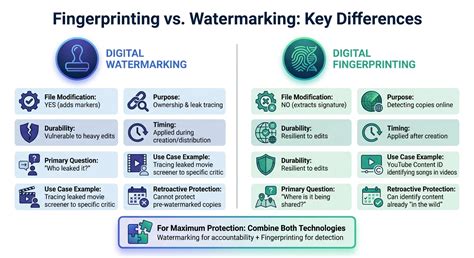
Fingerprinting builds a unique signature from the content itself and needs no involvement from whoever made the content. Watermarking works the other way: a broadcaster or content owner embeds an inaudible or invisible tag into the signal before it’s ever distributed, and a compatible device reads that tag later.
| Technique | What it requires | Who controls it | Typical use case | Known limitation |
|---|---|---|---|---|
| Acoustic/video fingerprinting | Nothing from the content owner; the vendor builds its own reference library from the content | The device manufacturer or ACR vendor | Smart-TV viewing identification, song ID | Only works on content already in the reference library |
| Digital watermarking | A tag embedded in the signal before distribution | The broadcaster or content owner | Second-screen sync, broadcast-channel ID | Doesn’t retroactively cover content that was never tagged |
| Hybrid fingerprint + watermark | A reference library plus a cooperating broadcaster | Split between vendor and content owner | Cross-platform ad verification | More accurate, more expensive to deploy |
That difference in requirements is why ACR on ordinary smart TVs runs almost entirely on fingerprinting: no broadcaster cooperation is needed, so a vendor can point the same technique at any screen it can reach.
Is ACR the same as Shazam?
Shazam popularized audio fingerprinting for identifying songs, then extended the same underlying approach to TV content starting in 2011. Modern smart-TV ACR from Samsung and LG runs on comparable fingerprinting logic, but through each manufacturer’s private reference library rather than Shazam’s.
How Aggressively Each Brand Tracks You

Not every brand has been measured with the same rigor, and it’s worth saying so plainly rather than guessing.
| Brand | Fingerprint transmission | Works over HDMI | Opt-out toggle | Regulatory status, mid-2026 |
|---|---|---|---|---|
| Samsung | About once per minute, per peer-reviewed network measurement | Yes | “Viewing Information Services,” Settings → General & Privacy → Terms & Privacy → Privacy Choices, per Malwarebytes | Settled with Texas, Feb 26, 2026: must obtain express consent before collecting ACR data, per the Texas Attorney General |
| LG | About every 15 seconds, batched from frame captures LG’s documentation lists as occurring every 10 milliseconds, per the same measurement study | Yes | “Live Plus,” Settings → General → Additional Settings, per Malwarebytes | Settled with Texas via Agreed Final Judgment, May 11, 2026, barring ACR collection without affirmative express consent, per court-tracking reporting |
| Vizio | Not measured in the cited study; the company discloses an ACR-driven data program in its financial reporting | Not independently confirmed here | Not independently confirmed here | Still under the FTC’s 2017 consent order; Texas’s 2025 suit against it unresolved as of mid-2026 |
| Sony, Hisense, TCL | Not independently measured in the cited study | Not independently confirmed here | Not independently confirmed here | Named in Texas’s December 2025 suit; Hisense under a restraining order, Sony and TCL ongoing, per court-tracking reporting |
The 15-second-versus-one-minute gap matters for anyone estimating data volume: LG’s tighter interval means more individual data points leave a household per hour of viewing, even though both numbers describe the same underlying fingerprinting process.
Can ACR data identify me personally?
A fingerprint is a hash of the content on screen, not of the person watching. The researchers behind the 2024 audit note that sending a hash rather than raw content doesn’t make the data anonymous, since it’s still tied to a device or account identifier used for ad targeting.
Where ACR Data Goes: Advertising, Measurement, and Content ID

An ACR match turns into three kinds of business activity: an advertiser buys a targeted ad slot based on the matched program, a measurement firm folds the match into real-time audience numbers used to set ad prices, and a rights holder uses the same fingerprint logic to spot where its content is airing or being copied. Vizio’s Q3 2021 earnings, reported by FlatpanelsHD, showed its Platform+ segment, which bundles advertising and ACR-driven viewer data, generating $57.3 million in gross profit that quarter, more than double the $25.6 million its TV hardware business produced.
What ACR Can’t See: Real Limitations
ACR’s biggest blind spot has nothing to do with the technology itself: it’s licensing. The 2024 network audit found that certain aggregator and subscription streaming apps carry agreements with content owners restricting what an ACR client is allowed to capture, a restriction that doesn’t apply to linear broadcast or content arriving over HDMI. An advertiser or measurement team treating raw ACR reach numbers as complete household viewing data will overstate reach for any audience that watches much of its television inside apps carrying these restrictions.
Does ACR work the same on every streaming app?
No. Linear broadcast and HDMI-connected devices see the least restriction, while some aggregator and subscription apps carry licensing terms that limit what an ACR client can capture from them.
Turning ACR Off, Brand by Brand
Two brands have documented, verifiable opt-out paths at the time of writing.
- Samsung: Settings → General & Privacy → Terms & Privacy → Privacy Choices, then turn off Viewing Information Services.
- LG: Settings → General → Additional Settings, then set Live Plus to off.
A Texas court’s finding in the state’s case against Samsung, reported by BleepingComputer, described the original process as requiring more than 200 clicks spread across four or more separate menus, before the settlement forced a redesign. That figure is a useful benchmark for how bad an opt-out flow can get before regulators intervene.

Vizio, Sony, Hisense, and TCL are all named in ongoing litigation over similar practices, but this page doesn’t have an independently verified, current opt-out path for any of them; that’s flagged here rather than guessed at.
Does turning off ACR stop all TV tracking?
No. The ACR toggle stops content-recognition fingerprinting specifically. Voice recognition, app-usage analytics, and other data collection typically live under separate settings and need to be checked on their own.
The Regulatory Shift: From a $2.2 Million Fine to Mandatory Consent
The gap between the FTC’s 2017 Vizio case and 2026’s settlements is enforcement design: the 2017 case punished a practice after 11 million TVs had already been affected, while the 2026 Texas settlements and Kentucky’s new law push toward consent obtained before collection starts.
| Date | Actor / action | Outcome |
|---|---|---|
| February 2017 | FTC and New Jersey AG v. Vizio | $2.2 million settlement; 11 million TVs affected; no prior consent obtained |
| December 15, 2025 | Texas AG sues Samsung, LG, Sony, Hisense, and TCL | Alleged ACR collection without meaningful consent |
| February 26, 2026 | Samsung settles with Texas | Must obtain express consent before ACR collection; no monetary penalty disclosed |
| April 13, 2026 | Kentucky Governor signs HB 692 | Reclassifies ACR data as sensitive under state privacy law; effective July 1, 2027 |
| May 11, 2026 | LG settles with Texas via Agreed Final Judgment | Barred from ACR collection without affirmative express consent |
As of mid-2026, Sony, Hisense, and TCL remain in active litigation, with Hisense still under a restraining order.

Evaluating an ACR Vendor or Partner
Anyone integrating an ACR provider, or buying ACR-based audience data, has real questions to ask before signing anything:
- Coverage gaps: does the vendor disclose which aggregator or subscription apps its client can’t fully capture, given the licensing restrictions documented in the 2024 audit?
- Consent design: does the onboarding flow require anything close to Texas’s documented 200-click, four-menu problem, or a clean express-consent screen?
- Regional behavior: if the deployment spans the UK and US, does the vendor disclose the documented differences in how ACR tracking behaves between the two markets?
- Opt-out verification: does opting out actually stop network traffic to the vendor’s servers, the standard the 2024 study confirmed for the platforms it tested, or does it merely suppress a dashboard while data keeps flowing?