Hardware: what physically changed between generations
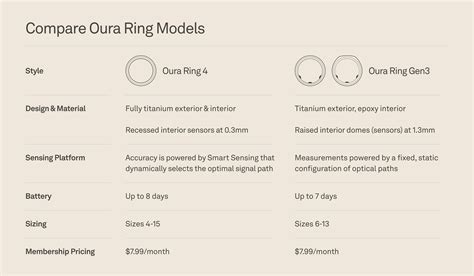
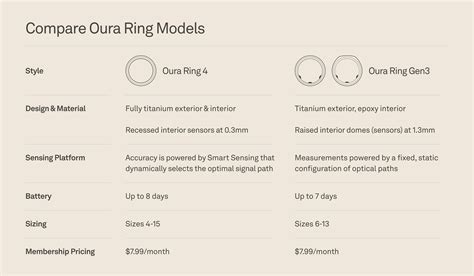
The move from Ring 3 to Ring 4 wasn’t cosmetic. Oura replaced the resin inner molding with an all-titanium build and increased the optical signal pathways used for its “Smart Sensing” system from 8 to 18 (Oura). Ring 4 also widened the size range to 4 to 15, up from 6 to 13 on Ring 3 (Oura Help), and its sensor domes protrude only about 0.3mm inside the ring, a notable reduction from Ring 3’s raised sensors (Tech Advisor).
Ring 5 goes further still. At 6.09mm wide and 2.28mm thick, weighing 2g to 2.69g depending on size, Oura describes it as 40% smaller than Ring 4 (Oura; Tech Advisor). Ring 4 measures 7.9mm wide and 2.88mm thick and weighs 3.3g to 5.2g (Tech Advisor). Ring 5 also drops to 12 signal pathways, trading pathway count for larger, brighter LEDs that Oura says improve skin contact (BusinessWire).
| Attribute | Ring 3 (Gen3) | Ring 4 | Ring 5 |
|---|---|---|---|
| Signal pathways | 8 | 18 | 12 |
| Sizes available | 6 to 13 | 4 to 15 | 6 to 13 |
| Width / thickness | Not published by Oura | 7.9mm / 2.88mm | 6.09mm / 2.28mm |
| Weight | Not published by Oura | 3.3g to 5.2g | 2g to 2.69g |
| Interior material | Resin inner molding | All-titanium | All-titanium |
| Styles offered | Horizon and Heritage | Rounded only | Rounded only |
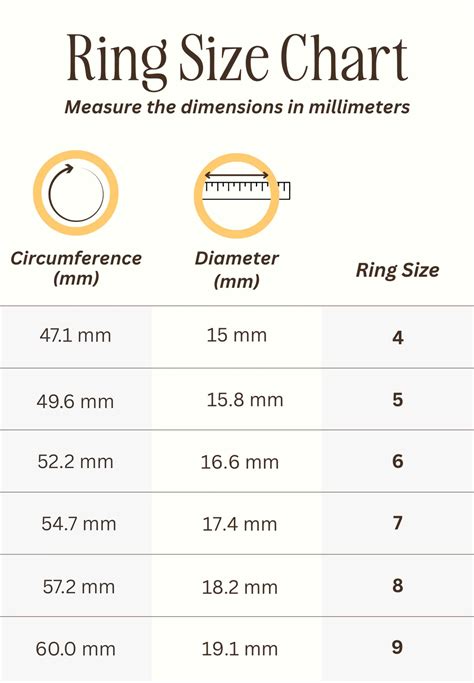
The sizing gap is the one hard disqualifier in this table: Ring 5 ships in sizes 6 to 13 at launch, narrower than Ring 4’s 4 to 15 (Forbes Vetted), so anyone at the small or large end of that range currently has only one ring that fits.
Does Ring 4’s larger size range actually matter for most buyers?
It matters specifically for people outside sizes 6 to 13. Ring 4’s 4-to-15 range exists for that population; Ring 3 and Ring 5 both stop at size 13.
Battery life and offline storage, generation by generation
Battery claims have widened, not tightened, with each release. Ring 3 is rated for up to 7 days (Oura Help). Ring 4 is rated up to 8 days, with a full charge taking up to 120 minutes (Oura). Ring 5, despite being 40% smaller, is rated between 6 and 9 days in Oura’s own support documentation (Oura Help), a figure independently reported by TechCrunch against Ring 4’s 5-to-8-day range (TechCrunch).
| Ring 3 (Gen3) | Ring 4 | Ring 5 | |
|---|---|---|---|
| Claimed battery life | Up to 7 days | Up to 8 days | 6 to 9 days |
| Charge time (0 to 100%) | Not separately published | Up to 120 minutes | Not separately published |
| Offline data storage (no sync) | Up to 7 days | Up to 7 days | Up to 3 days |
| Optional charging case | Not available | Not available | $99, holds 1 month of charge |
The offline-storage row matters more than the battery-day claims themselves: Oura’s own documentation confirms Ring 5 holds only 3 days of data without syncing, against 7 days on both Ring 3 and Ring 4. Anyone who goes several days between phone syncs, through travel or simply forgetting, loses data on Ring 5 that either older ring would have kept.
Sleep accuracy: what’s actually been independently verified
Most of what circulates about Oura’s accuracy is Oura’s own marketing. Exactly one independently peer-reviewed study exists in this space, and it covers only the Ring 3 generation. Researchers at Brigham and Women’s Hospital compared the Oura Ring Gen3 against gold-standard polysomnography across 35 participants and 421,045 sleep epochs, publishing the results in Sensors in October 2024 (Robbins et al.; PubMed). Oura Ring Gen3 scored 76.0% to 79.5% sensitivity for four-stage sleep classification, with 68.6% sensitivity for wake detection against 67.7% for Fitbit Sense 2 and 52.4% for Apple Watch Series 8, and 79.5% sensitivity for deep-sleep detection against 61.7% for Fitbit and 50.5% for Apple Watch (Sleep Review). For context, polysomnography itself only reaches 83% agreement between two human scorers reviewing the same night (BusinessWire), so no consumer device is being measured against a perfectly reproducible standard.
Has Oura Ring 4’s claimed accuracy improvement been independently verified?
Not yet, as of this writing. The only peer-reviewed accuracy study on Oura hardware evaluated the Gen3 sensors specifically; the Ring 4 percentages are the company’s own internal comparison.
Availability and price: Ring 3 is gone
On October 3, 2024, the day Oura announced Ring 4 for preorder at $349, it cut the price of remaining Ring 3 stock to $299 from its prior $349-and-up pricing (The Hollywood Reporter). Ring 4 began shipping on October 15, 2024 (CNBC). Oura has since stopped selling Ring 3 through its own store; any unit available now comes from third-party retailer clearance stock or the secondhand market, with no guarantee of remaining warranty coverage.
New software features aren’t gated to Ring 4 alone. Oura confirmed that, starting October 3, 2024, updates including expanded Automatic Activity Detection and Cycle Insights roll out to both Ring 4 and Gen3 members (Oura).
Can I still buy an Oura Ring 3 new from Oura in 2026?
No. Oura discontinued direct sales of Ring 3 once Ring 4 shipped in October 2024; any new-in-box unit today is leftover third-party retailer stock, not a current Oura product.
Should you upgrade from a Ring 3?
- Your finger size sits outside 6 to 13: only Ring 4 currently covers sizes 4, 5, 14, and 15, so this alone settles the decision for that group.
- Daytime SpO2 or breathing-disturbance readings drive your decisions: that’s specifically where Oura’s own claimed Ring 4 improvements concentrate, even though they remain internally sourced.
- The raised inner sensor domes bother you during sleep or gripping activity: Ring 4’s recessed, 0.3mm domes address that directly; Ring 3’s do not.
- You’re on a fixed budget and your Ring 3 already meets your needs: the only independently peer-reviewed accuracy study still points to the Gen3 sensor generation, and Ring 4 costs $50 to $150 more depending on finish.
Buying new in 2026: Ring 4 or Ring 5?
| Finish tier | Ring 3 (last retail price) | Ring 4 | Ring 5 |
|---|---|---|---|
| Base finish | $299 (clearance) | $349 | $399 |
| Mid finish | $349 to $399 at original launch | $399 | Not offered at this tier |
| Premium finish (gold, ceramic, etc.) | Up to $449 to $549 at original launch | $499 | $499 |
If you’re buying new today, Ring 3 isn’t really on the table. The choice is between Ring 4 at $349 to $499, in stock now with the widest size range Oura has offered, and Ring 5 at $399 to $499, in stock from June 4, 2026, smaller and rated for a slightly longer battery window but limited to sizes 6 to 13 at launch (Forbes Vetted).
Ring 5 also arrived only about 18 months after Ring 4, compared with roughly three years between Ring 3 and Ring 4 (TechCrunch). That shorter cycle is worth weighing on its own: Oura is now iterating faster than its own history suggests, which matters if you’d rather not face this same decision again in another eighteen months.
Should I buy Ring 4 now or wait on Ring 5’s sizing?
If your finger size falls between 6 and 13, Ring 5’s smaller footprint and slightly longer rated battery life are available today. Outside that range, Ring 4 remains the only option until Oura expands Ring 5 sizing.
Ring 5’s storage limit deserves its own line, apart from everything above. If you go more than three days between phone syncs, whether from travel or simply forgetting, Ring 5 will lose data that Ring 3 or Ring 4 would have preserved.
What no generation has solved yet
Every current and past Oura ring still requires an active $5.99 monthly or $69.99 annual membership to unlock most metrics beyond the three headline daily scores (Oura). None of the three generations has published independent, multi-year data on battery-capacity degradation. Oura’s own documentation covers charging behavior and safety limits, not how much capacity a ring retains after twelve or twenty-four months of daily wear.