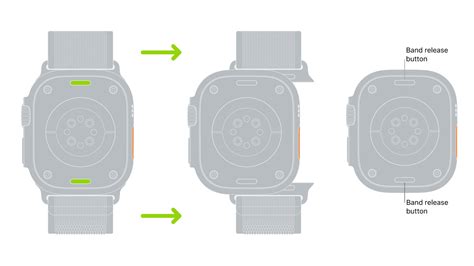
Which situation matches yours
Apple Watch bands fail to release in four distinct ways, and each points to a different fix.
| Symptom | Likely cause | First action |
|---|---|---|
| Button won’t depress at all, feels solid | Grime packed behind the button, or pressing with a fingertip instead of a firm point of contact | Press with a fingernail or a plastic pick instead of a fingertip; clean around the button edge first if it’s still solid |
| Button depresses fully but band won’t slide | Dried sweat, lotion, or sunscreen residue coating the connector rail | Clean the exposed rail edge with isopropyl alcohol on a cotton swab, hold the button down, and slide with steady sideways pressure |
| One side released normally, the other won’t move | Each side releases independently | Treat the stuck side on its own; the working side has no bearing on it |
| Band slides partway, then catches | A connector sitting slightly out of the rail, or tilted at an angle | Slide the band back toward center first, then retry; don’t pull upward or force it further out |
The four failure modes trace back to two different problems: residue blocking the moving parts, or a connector that isn’t sitting flat in the rail. Only the second one carries real risk of damage if forced.
Why did one side of my band release but not the other? A physical teardown of the original Apple Watch found the release mechanism uses two separate spring-loaded pins, one per side of the band, confirmed by iFixit’s X-ray teardown as dual, independent locking mechanisms. That’s why cleaning or pressure on one side has no effect on the other.
Try this first, safely
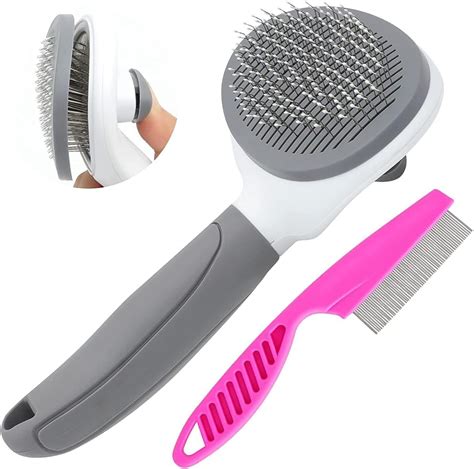
Most stuck bands respond to cleaning alone, with nothing beyond a cloth, a cotton swab, and isopropyl alcohol. Turn the watch off and lay it face down, then locate and press the release button firmly. Apple’s own instructions note that if the band doesn’t slide out the first time, press the button again and hold it down fully, not just tap it, before sliding. When reinstalling any band, slide it in until you feel and hear a click.
Which stronger fixes are safe, and which risk damage
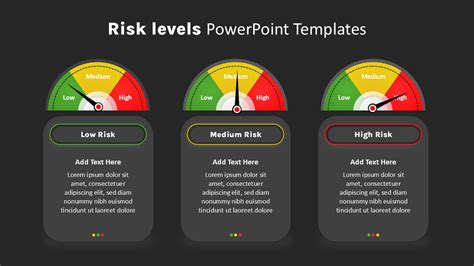
Apple’s own cleaning guidance rules out several of the internet’s most common suggestions outright.
| Remedy | Risk level | Safe condition |
|---|---|---|
| Dry brushing with a soft-bristle brush | Low | Always safe |
| Isopropyl alcohol on a cotton swab | Low | Safe on the exterior band slot for all models; avoid ports and speaker |
| Brief rinse of the slot under running water | Medium | Safe only with a water-resistant watch and band; see the generation table below |
| Heat from a hairdryer | High | Not part of Apple’s guidance for any model; can affect adhesives and seals |
| Compressed air or aerosol dusters | High | Explicitly against Apple’s own cleaning guidance |
| WD-40 or household lubricant | High | Not an Apple-approved cleaner; oil-based residue can attract more grit |
Every high-risk item on this list adds energy or a foreign substance to a sealed mechanism, and Apple’s documented steps use neither.
Water resistance by generation
| Watch generation | Water-resistance rating | Standard | Safe for a slot rinse |
|---|---|---|---|
| Series 1 / original Apple Watch | Splash-resistant (IPX7) | IEC 60529 | No |
| Series 2 through Series 8, SE (1st and 2nd gen) | 50 meters | ISO 22810:2010 | Yes, brief rinse only |
| Series 9 and later (non-Ultra) | 50 meters | ISO 22810:2010 | Yes, brief rinse only |
| Ultra and Ultra 2 | 100 meters | ISO 22810:2010, EN13319-compliant | Yes |
The rating applies to the watch case, not automatically to the band: Milanese Loop, Link Bracelet, and leather bands, including Hermès leather and knit bands, are never water resistant, no matter which watch they’re on. Series 1 owners should treat the band slot as dry-clean-only.
Is it safe to run my Apple Watch under water to loosen a stuck band? Only if the watch is Series 2 or later and the band itself is a water-resistant material. On any model, Apple’s guidance calls for fresh water only, never soap, and drying with a lint-free cloth afterward.
What’s inside the release mechanism
The button-and-slide design hasn’t changed since the original Apple Watch shipped in 2015. Engineers who built the parts told The Verge that each band tooth is machined on a dedicated assembly they called X206, using CNC machines costing roughly $2 million apiece that cut nothing else on the watch. A physical teardown of that first model confirms the result: a spring-loaded metal peg locks into the case and releases only when the button is pressed.
When to stop and get professional help
Does Apple charge to remove a stuck band? Diagnosis is free at any Apple Store Genius Bar. If actual repair or replacement is needed, Apple provides a cost estimate first; there’s no published flat fee specifically for band removal.
Third-party bands: an open question

Whether cheaper third-party bands jam more often than Apple’s own is a reasonable question with no independently published answer. Teardown documentation shows how precisely Apple machines its own connector pins, but no test lab has published comparable tolerance data for third-party replacements. Until that data exists, judge a third-party band by fit and finish rather than price alone.
Preventing the next jam
Apple’s own maintenance guidance is short: keep the band slot away from the substances that damage water seals in the first place, including soap, lotion, sunscreen, and perfume. A quick wipe with a dry cloth after a workout, and removing the band occasionally to check for residue even when you’re not swapping it, covers most of it.
How often should I clean the band slot to avoid this? Apple doesn’t publish a fixed interval. A practical cadence is a wipe after any workout or heavy sweating, since sweat and lotion are the exact substances Apple flags as risks to the seals.